A Most Brutal Murder
| Newspaper: | Rock Creek Record |
|---|---|
| Publication Date: | Jun 6, 1896 |
| Published at: | Quigley, Montana |
| Page Number: | 1 |
Article Transcript
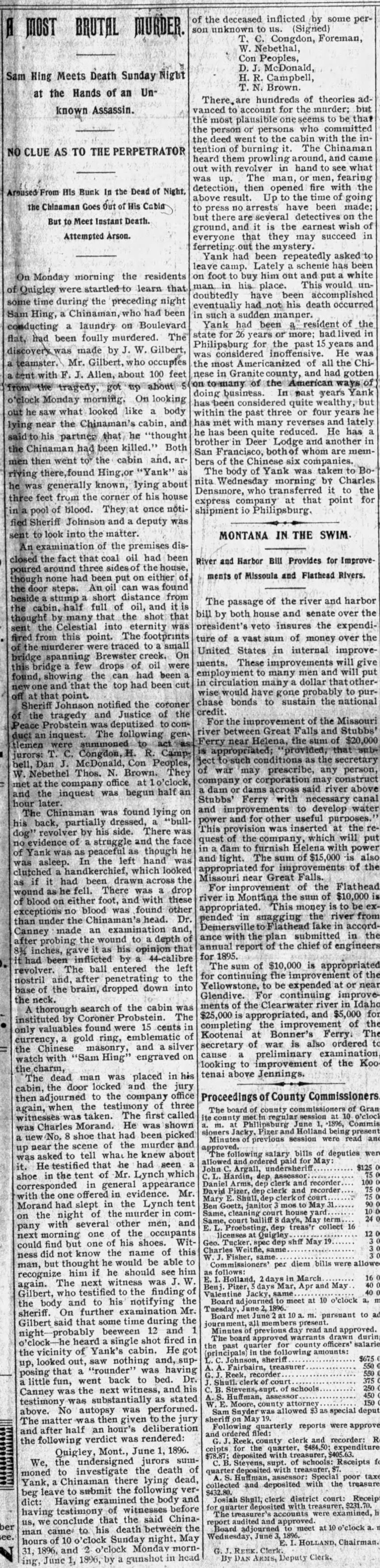
A MOST BRUTAL MURDER.
Sam Hing Meets Death Sunday Night at the Hands of an Unknown Assassin.
NO CLUE AS TO THE PERPETRATOR.
Aroused From His Bunk in the Dead of Night, the Chinaman Goes out of His Cabin But to Meet Instant Death. Attempted Arson.
On Monday morning the residents of Quigley were startled to learn that some time during the preceding night Hing Ah, a Chinaman, who conducted a laundry on Boulevard, had been foully murdered. The first to discover the tragedy was J. W. Gilbert, who, about 8 o’clock Monday morning, on looking out he saw what looked like a body laying near the Chinaman’s cabin, and on going to his place, found that the Chinaman had been killed. Both front and rear doors of the cabin were open, and everything around, including Hing, or ‘Yank’ as he was generally known, bore evidence of blood. They at once notified Sheriff Johnson and a deputy was sent to look into the matter.
An examination of the premises disclosed that coal oil had been poured around three sides of the house, though none had been put on either the east or north side. At a short distance from the house a stump of oil was found and the earth in that vicinity showed signs of being wet by that oil. The east side of the house had been set afire, as shown by the charred siding, but it had gone out of itself before doing any serious damage.
The remains were examined by Coroner Congdon, and the coroner’s jury—T. C. Congdon, foreman; W. Neethal, Con Peoples, D. J. McDonald, R. Campbell, H. N. Brown—was impaneled and the inquest was begun. The Chinaman was found lying on his back, partially dressed, a “bull-dog” revolver by his side. There was no evidence of a struggle and the face of the victim was as peaceful as though he was asleep. In the left cheek was located a bullet wound, which looked as if it had entered when the man was struck on the head as he fell. There was a drop of blood on the right foot, and with those exceptions no blood was found. Dr. Innes, who examined the wound in the head after probing a depth of about an inch and a half, gave it as his opinion that it had been fired by a .44-caliber revolver. The ball entered the left cheek and was found flattened at the base of the brain, dropped two or three inches back of it.
A thorough search of the scene was instituted by Coroner Probstein. The Chinaman’s effects were gone over, including a gold ring, a Chinese razor, a few Chinese moneys, and a silver watch with “Sam Hing” engraved on the case. His cash was not in his cabin, the door locked and the key missing.
Three witnesses were taken and their statements corresponded in general appearance with the one offered above. Mr. Morand had slept in the Lynch tent on the night of the murder in company with several other men; the next morning one of the occupants could find no use of his shoes.
J. W. Gilbert said that some time during the night—probably between 12 and 1 o’clock—he heard a single shot fired in the vicinity of Yank’s cabin, got up, looked out, saw nothing, and returned to bed.
The jury returned a verdict that the deceased came to his death from a gunshot wound of the head inflicted by some person unknown to us. (Signed)
T. C. Congdon, Foreman,
W. Neethal,
Con Peoples,
D. J. McDonald,
R. Campbell,
H. N. Brown.
There are hundreds of theories advanced to account for the murder; but the most plausible one seems to be that the person or persons who committed the deed went to the cabin with the intention of burning it. Hearing him in, they fired the shot.
‘Yank’ had been a resident of the place for 26 years, coming here when a boy from San Francisco. He has relatives at San Francisco and at Butte, both of whom are members of the Chinese six companies.
The body of Yank was taken to Bonita Wednesday morning by Charles Densmore, the manager for the express company at that point, en route to Philipsburg.