Chinese Labor Convention
| Newspaper: | Memphis Daily Appeal |
|---|---|
| Publication Date: | Jul 14, 1869 |
| Published at: | Memphis, Tennessee |
| Page Number: | 4 |
Article Transcript
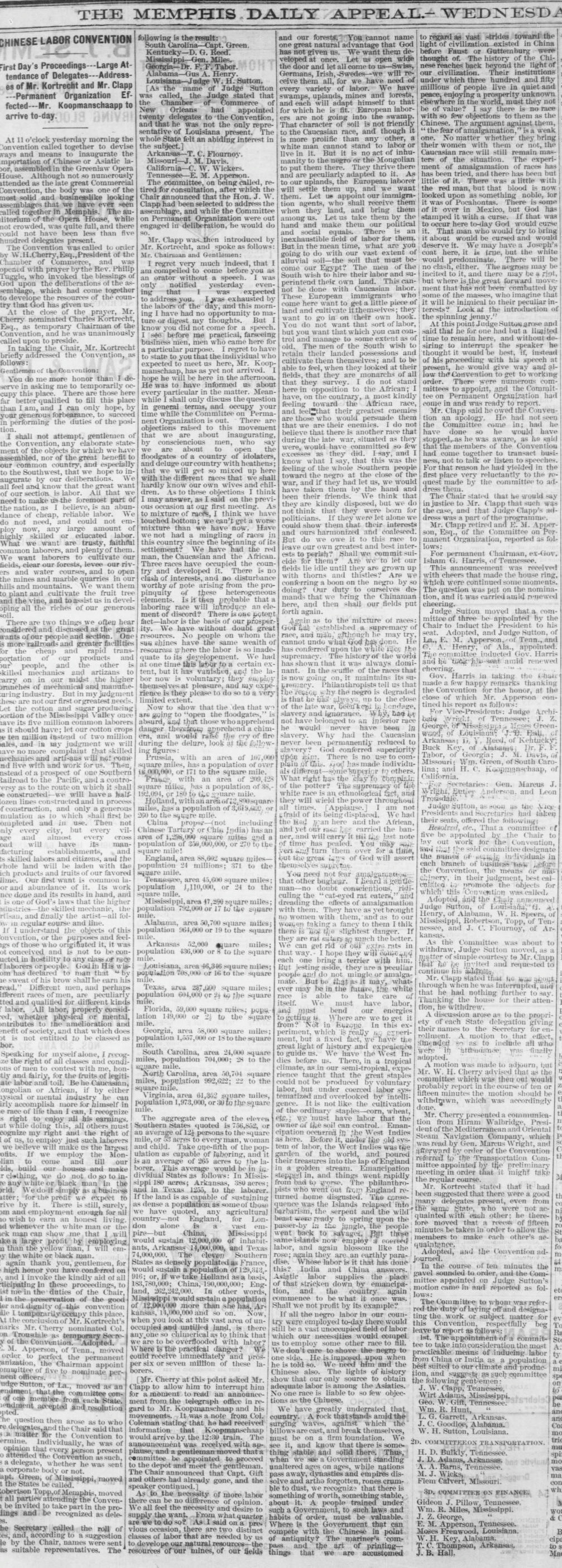
The Chinese Labor Convention. Memphis, Texx., July 13.—The Chinese Labor Convention assembled at 11 o’clock, at the Greenlaw Opera House. It was called to order by W. H. Chefry, President of the Chamber of Commerce. After prayer by Rev. Mr. Tuggle, Mr. Charles Kortchl was chosen temporary chairman, and responded in a brief address, setting forth the objects of the convention, and the great necessity for cheap labor in developing the resources of the country.
Colonel Trousdale was appointed temporary secretary, and a committee of one from each State represented was appointed on permanent organization. Colonel J. W. Clapp, of Memphis, then delivered an exhaustive address, in which he denied that the object of the meeting was antagonistic to white or black labor, but showed that in England the proportion of area was six acres to every laborer, while in the eleven Southern States it was 265 acres.
The committee on permanent organization reported for permanent chairman ex-Governor Isham G. Harris, of Tennessee, who, on taking the chair, made a brief speech, saying they had met for action, not for talking. A long list of Vice-Presidents and Secretaries was reported and confirmed. A committee of five, composed of Judge Sutton, of Louisiana; G. A. Henry, of Alabama; Robertson Tapp, of Tennessee; T. C. Flournoy, of Arkansas, and S. Peers, of Mississippi, on order of business, was next appointed.
After some unimportant proceedings, the latter committee reported the following as the order of business:
First—The appointment of a committee to consider and report upon the most practicable means of inducing labor from China and India—a population best suited to the climate. Of this committee J. W. Clapp was appointed chairman.
Second—The appointment of a committee on transportation, finance and immigration.
A telegram was received from St. Louis saying Koopman Shoop would be here tomorrow. The convention then adjourned to ten o’clock to-morrow. The meeting was very large, and represents the capital of the Southwest. Delegates are continually arriving.
St. Louis, July 13.—Koopman Shoop, the coolie contractor, from San Francisco, left here this afternoon to attend the Memphis Convention. He says the Chinamen who are now on the Pacific coast are receiving as much or more in the way of monthly wages than they can hope to get in the Southern States, and that the demand which the Memphis Convention is about to inaugurate must be met by new importations of coolies direct from Asia.—If the wages fixed upon at Memphis be satisfactory, he will engage to enter at once upon the business of bringing them across the Pacific ocean and thence direct to the Southern lands.
From the Memphis Avalanche, of Thursday, we condense some points of the proceedings of the Chinese Labor Convention, on Wednesday:
Gen. Gideon J. Pillow, Chairman of the Finance Committee, submitted a report recommending the organization of a stock company with a capital of $1,000,000—subject to be increased to $2,000,000, if necessary—as the most feasible plan to supply labor. Stock books to be opened at once, and remain open until the 15th of August. Shares to be rated at $100. A President and Board of Directors are also provided. The report was adopted, with the amendments that books of subscription be opened also in New Orleans and Mobile.
Maj. H. D. Bulkly, Chairman of the Committee on Transportation, reported that the cost of transportation of laborers from San Francisco or Sacramento via the Central and Omaha and St. Louis Railroads, and Memphis and St. Louis Packet Company to Memphis, Tennessee, will be as follows: In lots of one hundred to five hundred, $55 each, in currency; in lots above five hundred, $50 each, in currency. The above figures are given as being rates at which contracts can be made. From Memphis to any point in the interior of Tennessee, Mississippi, Alabama, Georgia and South Carolina, upon the lines of the various railroads, the rates will be one cent per mile.
A communication was read by Gen. N. B. Forrest from Mr. W. M. Gibson, originally from South Carolina, but for many years a resident of the Sandwich Islands, where he owns extensive lands, and employs Chinese and Japanese laborers. This communication recommended the necessity of selecting the laborers in China, with reference to the character of work to be performed. When ordered through a mercantile house at San Francisco or Hong Kong, they would probably disappoint expectation. Mr. Gibson recommended the Japanese as a desirable class of laborers. If not quite so energetic as Chinese, they are more docile, and would become desirable colonists and permanent laborers. Holding a commission from the King of the Sandwich Islands to proceed to Asia to secure laborers for the Islands, he would be happy to assist in contributing to the welfare of his old and beloved home, knowing how important a judicious Chinese immigration would be in the development and restoration of the South.
Captain Speers, of Mississippi, entered his protest against the introduction of Chinese laborers into the South, because of their heathen idolatry, and the disastrous effect it would have on the coming election in Mississippi, as the negroes would be told that the Chinese had been brought here to drive them out.
Tye Kim Orr, a live Chinaman, dressed American Summer fashion, and without the inevitable “tail,” but with the unmistakable Chinese features and color and bright olive eyes, delivered an address to the convention, in which he warned the people of the South against bringing the Chinese here indiscriminately. He said they generally made contracts for about five years, and the best place to get them from was the Southern part of China, in the provinces of Canton and Amoor. If any of them brought their wives with them they would also work in the fields, for it was only in the cities that women had small feet. [Laughter.] He went on to remark that field laborers were about the middle size, and worked best under a Chinese overseer, with a white superintendent. Their pay was about $15 per month, while the overseer got $20 or $25. They were willing to do anything, and were not treacherous or vicious. Very few were fond of liquors, and they don’t like whisky, and he only took one drink every Sunday. [Laughter.] They get along with the white people very well, but when brought into contact with the negroes they sometimes fight, and the negroes being stronger get the better of them. He said they were well acquainted with all kinds of farm work, and would soon learn to do any kind of work on a cotton plantation as they were very imitative, and always tried to do what they were told, besides being docile and quiet.
Col. Koopmanschaap, a Chinese delegate from California, was introduced to the convention, and warmly welcomed. He had been connected with the bringing of 50,000 or 60,000 Chinese to California, and a very large number of them had been employed on the Pacific Railroad, and about 3,000 or 3,500 were at present still employed, where they were paid $1 to $1 10 per day in gold. He thought, however, they could be got here for $12 per month. In Cuba, where living was cheap, they were paid $5 to $8. He was of the opinion that the cost of transportation from China would be from $80 to $100. If contracts should be made they will be made from two to five years.
General Gideon J. Pillow moved that a committee of three be appointed to confer with Mr. Koopmanschaap and Mr. Orr, and report the result of the conference.
Mr. Peebles moved, in amendment, that one delegate from each State compose the committee. Carried; and the following committee were selected: J. W. Clapp, Tennessee; John Williams, Louisiana; Jno. Martin, Kentucky; T. C. Flournoy, Arkansas; B. T. Blewitt, Mississippi; Gus A. Henry, Alabama; W. Green, South Carolina; F. F. Taber, Georgia.
Maj. Giles N. Hillyer, of Mississippi, from the “Committee on Immigration Generally,” submitted an elaborate report on the subject, concluding with an invitation from the South and Southwest to come with their capital and muscle, and pledging a welcome and the same protection the laws give the Southern citizen.
On the third and last day of the convention, the Chair announced that the following gentlemen had been appointed committees in their several States, to open stock books and organize auxiliary immigration associations: [list continues, including Tennessee, Louisiana, Mississippi, Kentucky, Arkansas, Virginia, South Carolina, etc.] General Gideon J. Pillow, W. A. Cherry, Clapp and Judge Archibald Wright.
General Pillow announced that Mr. Koopmanschap had subscribed $5,000, which was received with applause.
A letter was read from Commodore M. F. Maury, endorsing Chinese labor as much more intelligent, skillful and effective than negro labor, and considering its introduction, under proper regulations, as highly beneficial to the South.